Chant to End All the Wars in You
Chant to End All the Wars in You
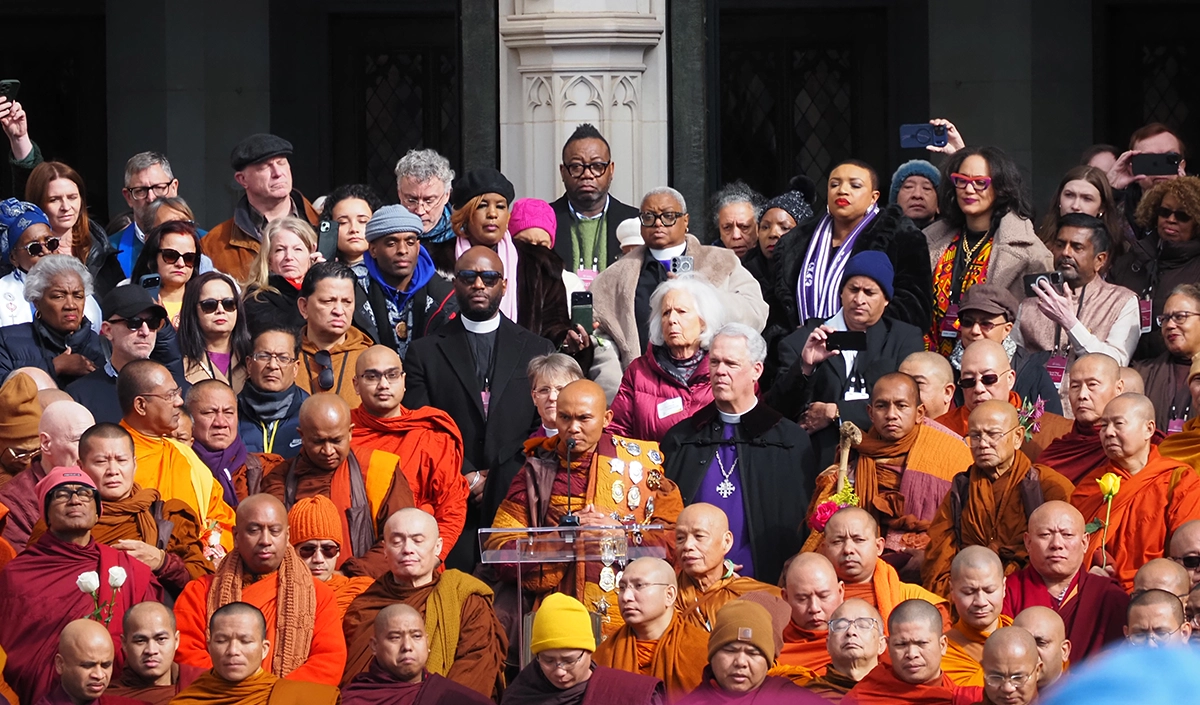
After a four-month, 2,300-mile journey, 19 monks on a mission to raise “awareness of peace, loving-kindness, and compassion across the United States of America and the world” arrived in Washington, DC.
Many walked barefoot, an energetic grounding technique to help individuals stay present. They left the Huong Dao Vipassana Bhavana Center in Fort Worth, Texas, on October 26, 2025, carrying nothing but their robes, alms bowls, and essential care items. Along the way, they faced frigid temperatures, treacherous terrain, and peril. One monk even lost his leg.
Those of us who choose the spiritual path to guide our lives know that countless dark nights of the soul are part of the journey. We choose it anyway.
The monks’ “Walk for Peace” stirred something in me. Following their walk, I realized that no matter how many people they inspire along the way, their resolve will not unlock some hidden cabal of peace in the nation or the world. Listening to their leader, Venerable Bhikkhu Pannakara’s message, that their goal was to demonstrate that there is no greater journey than the inner one and that peace is an inside job. As a practicing Soka Gakkai International (SGI) Nichiren Buddhist, I am familiar with the hard task of “doing the work.” I chant Nam-myoho-renge-kyo daily. Chanting enables me to tap into my Buddha nature and transform obstacles into opportunities, wisdom, and create lasting happiness for myself and others.
Bearing witness to the monks’ odyssey reminded me that we do not just practice for ourselves, we practice for others. And their walk brought me back to a moment in my spiritual journey. Early one summer morning in 2023, I found myself doomscrolling on Instagram. I landed on a landmine of devastating images and stories about the impact of the war on the people of Gaza. The ones of children struck me most. Among the particularly heartwrenching stories was about the dozens of premature babies on the verge of death in the NICU. The hospital had been bombed. Electricity was out. Generators were dying, and so were the children. Seeing one tiny, fragile baby after the other struggling for every breath, broke me. I decided to do the only thing that I could do for those children: chant. I sat in front of my Gohonzon and started to chant for “peace in the Middle East.” As I chanted, I received unexpected guidance from the Universe: chant to end all the wars within you.
I was shook.
It never dawned on me to chant to end the “wars” in me. I started to think through the dramas and traumas that might be raging in the depths of my heart. What wars were raging in me that I needed to address? What if we lived in a world where people chanted to end the wars within themselves?
When the monks left their monastery, they did not leave for themselves. They left for the benefit of the people of the United States and the world to deliver a powerful message about peace. Bhikkhu Paññākāra states we have a “box” inside of us where we have locked away our peace and happiness, and mindfulness is the key to unlocking it.
The beauty of my Buddhist practice, and what we witnessed in the monks’ selfless journey, is the selfness of practicing for others. In this way, the practice is revolutionary, and while not overtly political, there are political implications. What does it mean to strive for peace for not just you, but also someone else?
The monks’ walk for peace is as much a spiritual act as it is a political one. It is not lost on me that the monks’ journey mirrors the historic 1963 March on Washington, led by Martin Luther King, Jr. Just as King stood at the Lincoln Memorial, encouraged by Mahalia Jackson to share his dream for the United States of America, the monks stood at that same memorial, bearing witness to the ongoing struggle for peace and justice and urging us to do the work of turning dreams into reality: look within, ask yourself the tough question: What wars are you fighting?
King understood the need for internal questioning in the peace journey. He developed the connection between inner transformation and social change long before we saw him on the steps of the Memorial. Though a Baptist Minister, King studied Buddhism and was deeply influenced by it, particularly through his friendship with Vietnamese monk Thich Nhat Hanh. The practice shaped his vision for the “Beloved Community.” He adopted Buddhist principles of compassion and mindfulness into his work for nonviolence, recognizing that true peace requires both inner work and outer action.
This intersection of Black political tradition and Buddhist philosophy is rarely discussed, yet it runs deep through our history. During Black History Month, when we honor the struggles, contributions, triumphs, and innovations of Black Americans, it’s crucial to reclaim this often-overlooked narrative, especially today, as much of Black history is being erased. The contemplative and spiritual dimensions of Black liberation movements included meditation, mindfulness, and inner transformation alongside direct action. These practices were often overlooked as connective tissue that powered the movement, then and now, and they deserve recognition. King wasn’t alone in this practice. Other Black leaders and thinkers, from Howard Thurman to jazz musicians like John Coltrane who explored Eastern philosophy to civil rights activists like Rosa Parks who practiced meditation, understood that the fight for justice required spiritual fortitude. The monks’ walk reminds us that the tradition of seeking peace through inner transformation is not foreign to Black political liberation movements. In fact, it has always been intertwined with it.
The monks’ odyssey from Texas to the capital comes as the United States goes through its own dark night of the soul. The nation is confronting the choices it is making as it walks away from its quest to live up to its ideals. From ICE raids to contentious Senate hearings to blatant erasure of Black contributions to the nation, and increasing rage across all segments of society, the question looms: will enough of us be willing to do the challenging work of inner peace building?
The monks’ teaching echoes the divine guidance I received: peace begins within you. Their barefoot journey across nine states, including the District of Columbia, wasn’t meant to change policy or shift political winds. It was a living demonstration that lasting peace can only emerge when individuals do the hard work of transforming their inner world. This is the radical truth that both Buddhism and King’s beloved community rest upon: we cannot create a peaceful world with unpeaceful selves. The external conflicts we witness—from wars abroad to divisions at home—are reflections of the conflicts we harbor within. When we commit to human revolution, when we confront our own anger, fear, and hatred through our daily practice, we participate in the only revolution that has ever truly mattered.
Recommendation – Lawrence Edward Carter, Sr. A Baptist Preacher’s Buddhist Teacher: How My Interfaith Journey with Daisaku Ikeda Made Me a Better Christian.
Every Win Unravels a Story and Unravels a Narrative
Every Win Unravels a Story and Unravels a Narrative It’s Women’s History Month, and it h